
Democratic Strategy Forum
Understanding the present.
Learning from democratic struggle.
Building the capacity to shape what comes next.
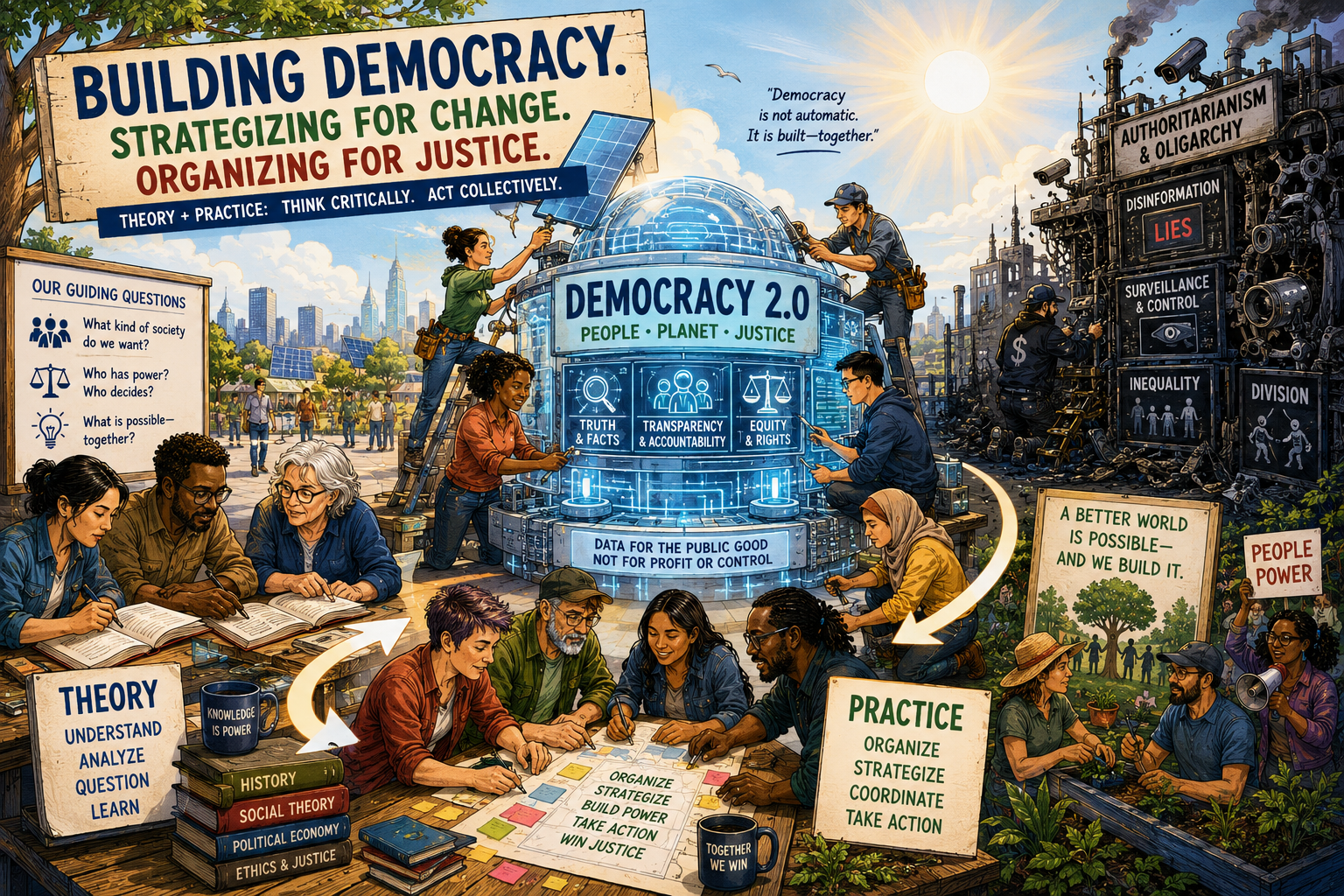
We bring history, research, and movement experience into conversation to understand how power works, how democratic possibilities are opened and closed, and what people and organizations can do together about it.
Democracy is not only something we inherit or vote for.
It is something people build, practice, defend, and deepen.
DSF is a project of the Southeast Community Research Center (www.cbpr.org), drawing on SCRC’s long experience with community-based participatory research and democratic practice.

What preparation already looks like
These groups are already preparing for democratic defense. Click the links below to learn more …
Indivisible — Election Defense Corps
Training volunteers in key states to defend election results.
UE Western Region — Election Defense
Labor/community coordination and, in some circumstances, a national economic boycott.
Strike Ready Corps
Training local blocks and preparing for a national strike if elections are subverted.
Hold the Line
Guide and training to mobilize nonviolently if election integrity is threatened.
May Day Strong
Labor and community network for coordinated mobilization and economic action.
Mass 50501 — Protect Our Vote
Advance pledges and coordinated response to election red lines.
Bay Resistance — Redline Plan
A pre-announced escalation plan, including sustained mobilization and noncooperation if elected members are blocked.
Freedom Trainers / Pace e Bene
Scenario-based trainings on collective action and defending certification if results are not upheld.

A NECESSARY CAVEAT
This essay does not assume that Democrats will win one or both chambers of Congress—or that, if they do, they will simply be allowed to take office. After 2020, we should be prepared for efforts to obstruct counting, certification, or the seating of lawful winners.
Nothing is fully settled until the votes are counted, the results are certified under law, and the new Congress is seated in January 2027. Only then will we know what political ground, if any, democratic forces have actually gained.
The essay’s central question begins after that: if the election is conducted under law and the winners are seated, what should democratic forces do with the ground they have won?
OUR FEATURED ESSAY
A democratic electoral victory would matter enormously—but only if the result is lawfully counted, recognized, and defended. Even then, winning ground would not restore the old normal or eliminate the forces that made authoritarian politics possible.
The real question is what democratic forces do with the ground they gain: whether they preserve the organizations, relationships, and power built through resistance—or let them dissolve after Election Day.
This essay argues for using any electoral opening to build a stronger democracy: durable organization, greater political equality, and more real power for ordinary people over the institutions shaping their lives.
Analyses and Strategies
STRATEGY & ORGANIZATION
Mass Demonstrations Are Not a Strategy
Mass demonstrations can show strength and build solidarity. The harder question is how they become part of an ongoing strategy that recruits, organizes, coordinates, and builds durable democratic power.
Elections matter, but they cannot substitute for the deeper organization and democratic power needed before, during, and after election day.
The Popular Front: What it is and Why It Is Needed Now
Authoritarian movements benefit from fragmentation. This essay asks what kind of broad, organized democratic alignment is needed when no single movement or institution can meet the danger alone.
The Organizational Failure: Why America Still Has No Democratic Popular Front
America does not lack organizations fighting to defend democracy. What it lacks is a durable structure capable of bringing them together and building power beyond any single election.
DEMOCRACY AS STRUGGLE
Old Institutions, New Movements, One Crisis
Older institutions and newer movements bring different strengths to the democratic struggle. The challenge is whether they can overcome fragmentation and build the coordination the present crisis demands.
100+ Years of Fighting for Democracy
American democracy has never simply expanded on its own. Its history is a recurring struggle between movements that widen democratic power and forces that seek to concentrate and restore power at the top.
AI, TECHNOLOGY & DEMOCRACY
Democratic Strategy in the Age of A.I.
AI is a political terrain, not a neutral tool. This essay asks how democratic movements can contest corporate control, build public understanding, and subordinate AI to democratic purposes rather than adapt to it passively.
The A.I. Revolution Nobody Voted For
The AI boom did not simply happen. This essay traces how public investment, private ownership, and capitalist expansion produced a technological revolution the public helped build but never democratically chose or controlled.
We welcome your thoughts. To respond to something you’ve read or add to the discussion, contact us at defend4demo@cbpr.org
_____________________________________________
DSF Resources
Download concise one-page guides, discussion tools, and educational resources designed to support democratic inquiry, workshops, and political education.
Browse the complete Resource Library →
Southeast Community Research Center
defend4demo@cbpr.org
ATHENS, GA 30601
DIRECTOR: Douglas Taylor (404) 394-3263
SCRC is a 501(c)(3) organization.
COPYRIGHT © 2026, SCRC. ALL RIGHTS RESERVED.