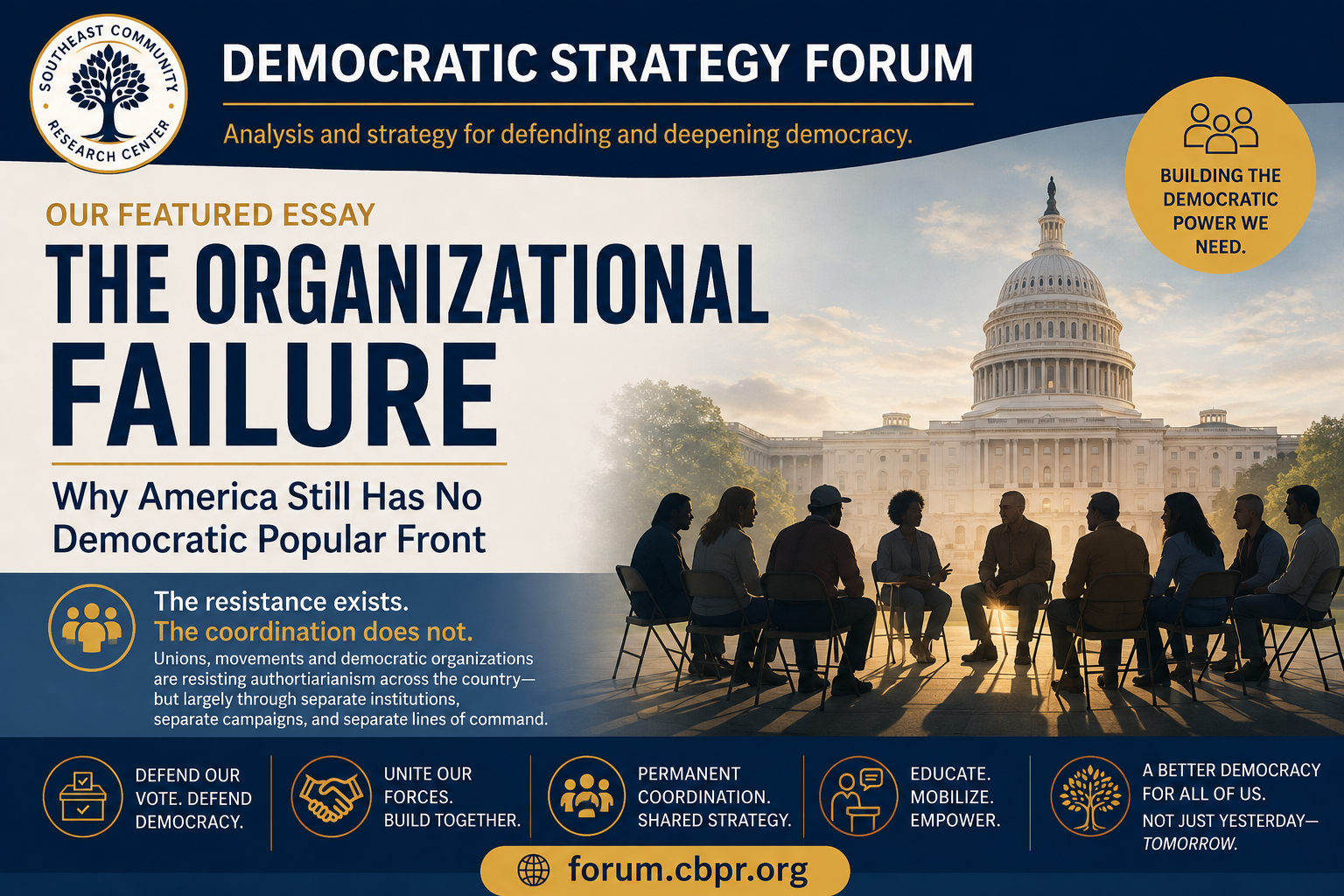
American democracy confronts an organized authoritarian movement. Its leaders concentrate executive power, attack and intimidate independent institutions, normalize political violence, and systematically undermine confidence in elections. The danger is no longer hypothetical, nor is it confined to the next election.
Yet the democratic response remains fragmented, temporary, and astonishingly ordinary. Unions, civil-rights organizations, women’s organizations, environmental groups, immigrant-rights organizations, faith communities, scientists, educators, veterans, students, and elected officials continue to resist—but largely through separate institutions, separate campaigns, and separate lines of command.
That is the organizational failure at the center of the present crisis.
The central lesson of the twentieth century is not merely that democratic societies must recognize authoritarian danger. It is that democratic forces must organize with the will, permanence, and scale necessary to meet it.
Why, then, are we still responding organizationally as though this were simply another difficult election?
The crisis did not begin with the present administration. For more than four decades, the United States has operated within a political and economic framework that concentrated wealth and power while weakening the institutions through which ordinary people once exercised a meaningful collective voice.
Beginning with the Reagan era, organized labor declined, corporations consolidated, public institutions were weakened, and market values extended into more areas of social life. Productivity and national wealth continued to grow, but the gains flowed upward. Wages for millions of working people stagnated, while housing, healthcare, higher education, and other necessities consumed a growing share of family income.
Republicans and Democrats often fought sharply over taxes, regulation, social policy, and the role of government. Yet for much of this period, both parties operated within a broad political settlement that treated concentrated private power as largely legitimate, weakened government’s capacity to act for the common good, and narrowed the range of alternatives considered politically possible.
As that settlement lost legitimacy, millions of Americans concluded that working harder no longer guaranteed greater security and that public institutions answered more readily to wealth than to citizens. On the right, authoritarian nationalism has redirected that anger away from concentrated economic power and toward immigrants, minorities, public institutions, and democratic restraints themselves.
The old settlement is fracturing, and the crisis has entered a more dangerous stage. An authoritarian movement is already organized to shape what comes next. Whether democratic forces can contest that future depends on whether they develop the organization, leadership, and common strategy necessary to act together.
If democracy is confronting one of its greatest challenges in generations, our response remains wildly uninspiring compared with the dangers present.
We hold press conferences. We issue statements. We file lawsuits. We organize rallies. We raise money. We recruit volunteers.
And, above all, we repeat the same refrain:
“Get out and vote.”
Voting matters. It is indispensable. Many democratic advances in American history have depended upon electoral victories. Every citizen who values constitutional government should vote, encourage others to vote, and defend the integrity of the electoral process.
But elections are not organization. Elections are not strategies.
And elections do not build the active and enduring democratic power necessary to resist an authoritarian movement before, during, and after Election Day.
Hospitals facing a category-five hurricane would activate emergency command systems, coordinate with neighboring institutions, marshal supplies, and establish common lines of communication. Firefighters confronting a massive wildfire would create unified command, share resources, and prepare together before the flames reached the community.
Yet organizations that warn daily about authoritarianism continue, for the most part, to fight separately and with the tools of ‘normal times.’
This is not a criticism of their commitment. Quite the opposite. America does not suffer from a shortage of courageous organizations.
We have labor unions representing millions of workers and civil-rights organizations with generations of experience. We have organizations defending women, immigrants, LGBTQ+ communities, scientists, educators, journalists, voting rights, constitutional law, environmental protection, public health, disability rights, and religious freedom. Thousands of local organizations are doing remarkable work every day.
The problem is not that these organizations are waging fights. The problem is that no permanent national structure exists whose principal mission is to unite them into a coherent democratic movement.
That organizational failure may be the single greatest weakness of those committed to defending constitutional democracy.
Broad democratic coalitions are rarely built because every participating organization agrees on all issues. They are built because people recognize that some threats transcend ordinary political disagreements.
Such coalitions do not erase ideological differences. Labor unions remain labor unions. Environmental and civil-rights organizations continue their work. Faith communities retain their own traditions and priorities.
What changes is not their identity. What changes is their understanding and commitment to coordination.
A permanent democratic alliance would not replace existing organizations. It would strengthen them.
Imagine representatives from labor, civil-rights organizations, women’s organizations, immigrant-rights organizations, environmental organizations, disability advocates, educators, scientists, veterans’ groups, constitutional lawyers, youth organizations, faith communities, and democracy organizations meeting regularly—not merely to exchange information, but to establish common priorities and coordinated campaigns.
Imagine shared research rather than duplicated research. Shared communications rather than competing messages. A coordinated media and reporting strategy capable of presenting local struggles as parts of one national democratic emergency. Joint mobilizations rather than isolated demonstrations.
Common legal strategy. Election protection coordinated nationally. Rapid-response teams prepared before crises emerge. State coordinating councils linked to local democratic assemblies.
A permanent infrastructure capable of responding collectively rather than institution by institution. Allocation of resources on basis of expertise, rather than duplication.
These are not radical proposals. They are the organizational form democracies have repeatedly adopted when confronting extraordinary threats.
Yet even if such an alliance were created tomorrow, one further lesson must be recognized.
A democratic movement cannot succeed by asking people “just defend yesterday.”
A coalition that promises only to restore the status quo will struggle to sustain public support. Millions of Americans have lived through decades of economic insecurity, declining opportunity, and growing distrust of public institutions. The democracy they are being asked to defend often failed to deliver for them. Simply asking people to return to that world will not inspire the commitment or sacrifice that this moment requires.
A democratic movement must therefore do more than preserve existing institutions. It must also demonstrate that democracy can improve ordinary lives and offer a credible vision of a better future.
Millions of Americans face stagnant wages, unaffordable housing, rising healthcare costs, insecure employment, and growing inequality. Many feel that despite working harder, they enjoy less security and fewer opportunities. Those frustrations are real, regardless of how people explain their causes.
Authoritarian movements flourish when democratic institutions lose credibility as vehicles for improving everyday life. They exploit economic insecurity, social fragmentation, and distrust, offering scapegoats in place of democratic solutions.
That means a movement dedicated to defending democracy must also be prepared to deepen democracy.
The promise cannot simply be to restore normal politics. It must be to build a democracy worthy of its citizens:
A democracy in which every worker earns a living wage; healthcare is a public right; affordable housing is a national priority rather than a privilege; workers possess the unqualified right to organize; wealth contributes fairly to the common good; public education, scientific research, and universities are defended; and concentrated economic power no longer exercises disproportionate influence over public policy.
These are not distractions from democracy.
They are among the conditions that allow democracy to retain legitimacy in the eyes of ordinary people. Defending constitutional institutions and expanding social and economic democracy are not separate projects. In this historical moment, each depends upon the other.
This is why we at the Southeast Community Research Center have repeatedly called for the immediate convening of a National Democratic Congress—a gathering of every organization committed to constitutional government, democratic rights, and the advancement of working people.
Not another conference. Not another symbolic declaration.
A working congress charged with creating a permanent coordinating council for democratic action before, during, and after the 2026 elections.
Its purpose would be to create an organization: a durable national structure through which participating groups could establish common priorities, coordinate campaigns, share information and resources, prepare for democratic emergencies, and sustain collective action beyond any single election.
Such a congress would not require every participant to adopt the same program or surrender its independence. It would require only the recognition that no organization, constituency, or political tendency can meet this crisis alone—and that democratic coordination must become as permanent and serious as the authoritarian movement it confronts.
The coming election may prove one of the most consequential in modern American history. It offers an opportunity to defend democratic institutions and reject authoritarian politics at the ballot box.
But regardless of the outcome, the work cannot end in November.
If democratic forces prevail, the coalition must remain to rebuild institutions, reduce inequality, expand democratic participation, and prevent authoritarianism from regrouping.
If democracy suffers another setback, the coalition will become even more necessary—as a structure for resistance, mutual protection, political education, and democratic reconstruction.
The election will shape the conditions under which this work proceeds. It cannot substitute for the work itself.
We will still have to strengthen labor, develop democratic leadership, educate and organize, defend those under attack, support candidates committed to expanding democracy, and build a broad, permanent, multi-organizational coalition capable of acting with common purpose.
Those are the tasks before Election Day. They will remain the morning after.
History will not judge the democratic movement by how many statements it issued, how many separate organizations it contained, or how accurately it described the danger.
It will judge whether those organizations learned to act together while there was still time.
The question is no longer whether the danger is real.
The question is whether our response will finally become equal to it.